

 en
en
 English
 русский
 Español
 عربى
عربى


Pressure Rating for HDPE Pipe: PN, SDR and DR Explained with Charts for Buyers
Industry News-Content
- 1 What the Pressure Rating on an HDPE Pipe Actually Means
- 2 The Standard Classes, Side by Side
- 3 Material Grade Changes the Rating at the Same SDR
- 4 Temperature: the 20°C Reference Is Not a Detail
- 5 Surge Pressure: the Variable That Surprises New Specifiers
- 6 Choosing a Rating in Six Steps
- 7 Five Procurement Mistakes That Show Up at Hydrotest
- 8 Where Rating Decisions Show Up in Real Systems
Ask two suppliers to quote the same DN200 HDPE water main and the figures can be far apart for what looks like the same pipe. Open the technical sheets and the reason is usually one line: one pipe is SDR 11 and the other is SDR 17. For a 200 mm line, that is an 18.2 mm wall against an 11.9 mm wall — more than 50% extra resin per metre — and it buys a rating of PN16 instead of PN10.
The pressure rating for HDPE pipe is not a property of the plastic alone. It is the product of three variables a buyer either controls or must verify: the material grade (PE80, PE100, PE4710), the diameter-to-wall ratio (SDR or DR), and the service temperature, because every rating on the market is referenced to water at 20°C. Fix those three variables and the specification almost writes itself. Ignore any one of them and you either pay for wall thickness the system will never use, or accept a main that fails its pressure test on the first warm afternoon.
What the Pressure Rating on an HDPE Pipe Actually Means
PN stands for nominal pressure and is quoted in bar: a PN16 pipe is rated to carry 16 bar of water continuously over a 50-year design life at 20°C. The 50-year clause matters more than it first appears. Ratings are derived from long-term hydrostatic strength regression, which is why short burst tests return numbers several times higher. A rating is a working figure with a built-in safety factor — never the burst figure.
Mathematically, the rating follows from the hoop stress the wall can carry: PN = 2σ / (SDR − 1), where σ is the design hoop stress. For PE100, the minimum required strength (MRS) is 10 MPa and the design coefficient for water applications is 1.25, so σ = 8 MPa. SDR 11 pipe therefore carries 2 × 8 / 10 = 1.6 MPa, in other words 16 bar.
North American practice states the same physics in different units. There the governing value is the hydrostatic design stress — 1,000 psi at 73°F for PE4710 — and the rating is 2 × HDS / (DR − 1), which makes a DR 11 line good for 200 psi. Since one bar is roughly 14.5 psi, PN16 and 200 psi are cousins rather than twins: the two systems use different safety coefficients and test bases, so the numbers never match exactly.
The Standard Classes, Side by Side
Most HDPE pressure pipe on the market falls into a short list of standard classes. If a quotation proposes something outside these rows, ask why before accepting it.
Metric: PN and SDR (ISO 4427 / EN 12201)
| SDR | Nominal pressure (PN) | Typical duty |
|---|---|---|
| 26 | PN 6.3 | Large-diameter, low-head transmission and gravity mains |
| 21 | PN 8 | Low-pressure irrigation and transfer lines |
| 17 | PN 10 | Rural supply and gravity-fed distribution |
| 13.6 | PN 12.5 | Distribution networks with moderate static head |
| 11 | PN 16 | The default for municipal water mains |
| 9 | PN 20 | Booster zones and high-head force mains |
| 7.4 | PN 25 | High-pressure industrial and process lines |
SDR is simply outside diameter divided by wall thickness, so the same PN value implies different absolute walls at different diameters. A DN200 PN16 line and a DN90 PN16 line are both SDR 11, yet their walls measure 18.2 mm and 8.2 mm.
North American: DR and psi (ASTM F714 / AWWA C906)
| DR | Pressure rating at 73°F | Typical duty |
|---|---|---|
| 26 | 80 psi | Gravity lines and low-head transmission |
| 21 | 100 psi | Low-pressure service and transfer mains |
| 17 | 125 psi | Rural water and irrigation mains |
| 13.5 | 160 psi | General distribution networks |
| 11 | 200 psi | Standard municipal water mains |
| 9 | 250 psi | High-head distribution and force mains |
| 7 | 333 psi | High-pressure industrial service |
DR is the same ratio built on a different series of preferred values, and US tables rate at 73°F rather than 20°C. That is close enough for selection, but confirm the reference temperature whenever a project spans both document sets.
Material Grade Changes the Rating at the Same SDR
MRS is where the grades separate: PE63 carries 6.3 MPa of minimum required strength, PE80 carries 8 MPa, and PE100 carries 10 MPa. At SDR 11, that progression moves the rating from PN12.5 on PE80 up to PN16 on PE100 with no change in outside diameter. US units tell the same story: PE4710 resin with 1,000 psi of design stress turns a DR 11 rating from the 160 psi of legacy PE3408 into 200 psi today.
This is why "SDR 11" written alone is not a specification. The grade belongs in the purchase order, and it must appear on the pipe marking. For the certificate landscape in detail — ISO 4427 and EN 12201 in Europe, AWWA C906 and ASTM F714 in North America — our guide to polyethylene pipe standards explains what each document obliges a manufacturer to prove.
Temperature: the 20°C Reference Is Not a Detail
Every PN or psi figure assumes 20°C water. Warm the pipe and the rating falls roughly in step: at 100°F expect about 90% of the cold rating, at 120°F about 80%, and at 140°F about 70%. A DR 11 PE4710 line rated 200 psi at 73°F therefore drops to roughly 160 psi at 120°F, and lower-grade resin can sink the same pipe into the 125–140 psi range. Black pipe in direct sun, a pump room in summer, or warm discharged process water can all reach those temperatures without anyone planning for them.
Where heat is continuous by design rather than accidental, engineers change material instead of chasing wall thickness. Floor heating circuits run for decades at 40–60°C, which is why they use PE-RT — a polyethylene engineered for sustained elevated temperature — rather than standard pressure pipe.
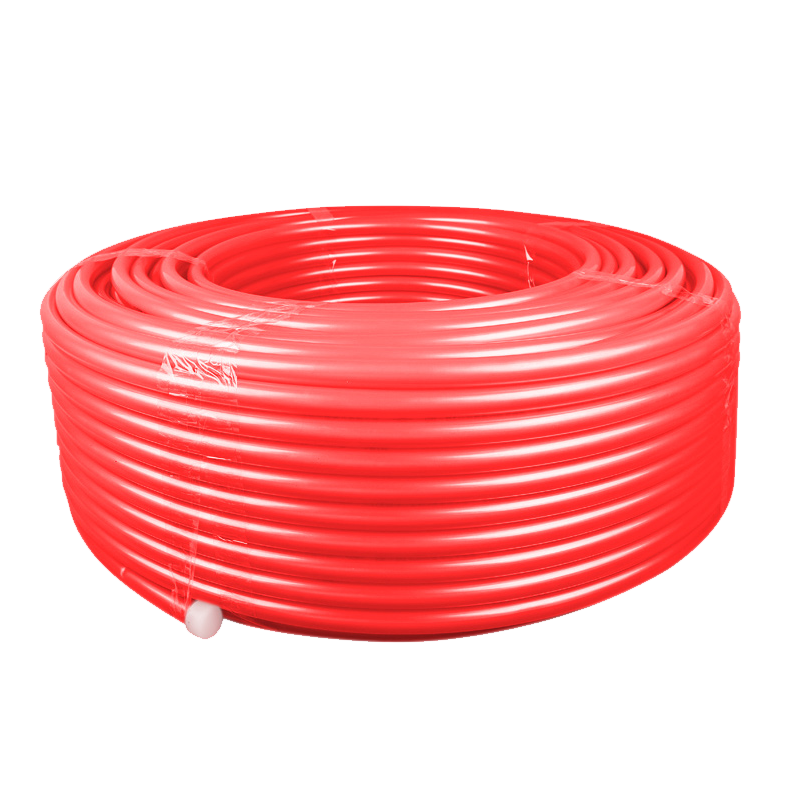 PE-RT Red Single-Layer Radiant Floor Heating PipePE-RT is engineered for the sustained 40–60°C duty of floor heating circuits, where standard pressure pipe would not last decades. This single-layer red pipe suits designers seeking a proven radiant heating material rather than extra wall thickness.View Product →
Surge Pressure: the Variable That Surprises New Specifiers
Pumps starting and valves closing quickly create short pressure spikes that ride on top of the working pressure. HDPE absorbs transients well because it is ductile and slightly deformable, and current PPI guidance for PE4710 credits a recurring surge allowance of about 1.5 times the pressure rating and an occasional-surge allowance near 2 times, subject to the DR and the governing standard. Treat those allowances as design inputs to verify, not as permission to skip transient control — slow-closing valves and soft pump starts remain cheaper than a fatigue failure at a poorly restrained elbow.
Choosing a Rating in Six Steps
- Establish the true maximum working pressure: static head plus the pump contribution. Keep the conversions handy — a 10 m column of water is about 1 bar, and 2.31 ft of head is about 1 psi.
- Confirm the sustained service temperature rather than the design-day average, then apply the derating factor.
- Characterize surge: count pump starts, review valve types, and mark the profile high points.
- Select the SDR or DR whose derated rating covers working pressure plus the recurring surge allowance, with sensible margin.
- Check availability in the required diameter, because the thinnest-wall classes are often restricted at large sizes.
- Match fittings, valves and transition joints to the same class or higher — a system is only as strong as its weakest component.
Five Procurement Mistakes That Show Up at Hydrotest
- Reading the burst pressure as the working rating. Burst numbers are typically multiples of the rating and say nothing about 50-year duty.
- Ignoring the temperature reference on installations that run warm. The pipe does not care what the drawing assumed.
- Mixing SDRs inside one pressure zone. The lowest-rated segment, not the average, defines the system rating.
- Assuming fittings inherit the pipe's class. Molded and fabricated fittings carry their own ratings and must be checked separately.
- Specifying diameter alone and leaving grade and SDR to the supplier's discretion — that is how PN10 pipe ends up installed on a PN16 drawing.
Where Rating Decisions Show Up in Real Systems
Buried municipal mains settle on PN16 (DR 11) as the default because it covers most distribution static heads with surge margin. Long transmission lines with controlled profiles often drop to PN10 and save real money on large diameters, while pressure sewerage force mains and industrial lines move up to PN20 or beyond. Building-side systems follow the same PN convention: PPR pipes are bought from PN10 through PN25 depending on duty, and PN20 is the usual choice for hot-water risers.
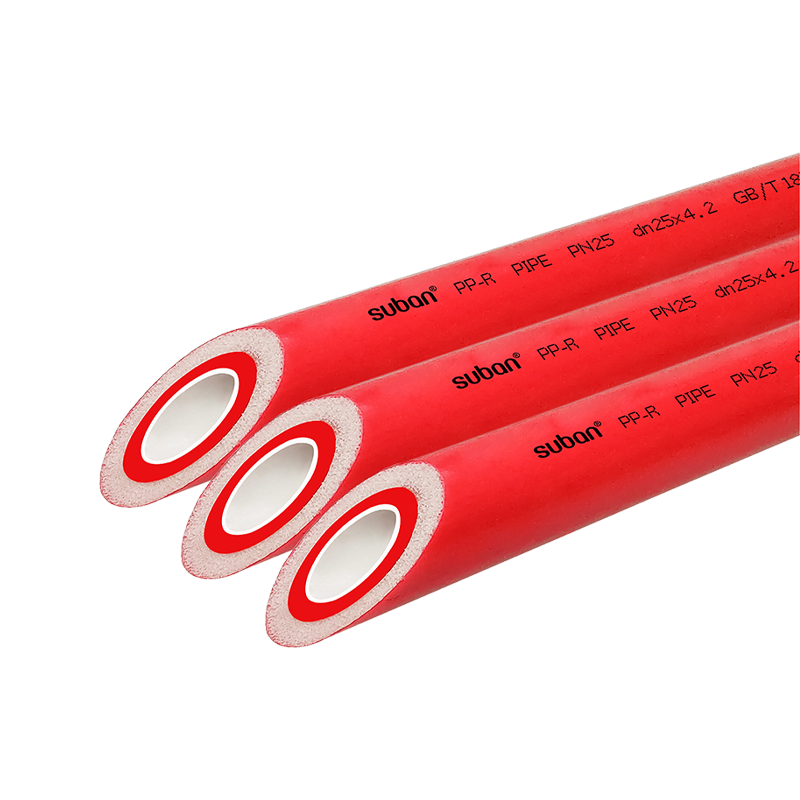 PPR Pipe ManufacturersBuilding-side systems buy PPR from PN10 to PN25 by duty, with PN20 typical for hot-water risers. Sourcing from export-oriented manufacturers means pressure ratings, certificates, and 1,000-hour hydrostatic test evidence are readily available.View Product →
Whichever system you buy, the verification routine is identical: request the pressure rating of the exact SDR and diameter in writing, the certificate for the governing standard, and evidence of the long-term hydrostatic tests behind the rating — the 1,000-hour test at 80°C is the one that separates a regression-based rating from a marketing claim. Export-oriented manufacturers used to project bidding supply these documents as a matter of course, so treat any hesitation as information.
Read a pressure rating as a sentence with three clauses — grade, wall ratio, temperature — and HDPE specification becomes arithmetic you can defend in a review meeting. As a pipe manufacturer supplying PPR, PE and PE-RT systems to buyers across more than 20 export markets, we ask for those three variables on every inquiry; it shortens the quotation, and it makes the system that arrives on site the one the drawing intended.
Our Product //
Recommend Products



 +86-13801995968
 +86-18017886575
 No. 366, Lane 6995, Puxing Road, Fengxian District, Shanghai
Copyright © SHANGHAI PILSA PIPE INDUSTRY CO., LTD. All rights reserved.

