

 en
en
 English
 русский
 Español
 عربى
عربى


HDPE Bending Radius: The 20-25x OD Rule, DR Limits, and Field Bending Guide
Industry News-Content
A 200 mm HDPE drainage main has to change direction around an existing storm chamber. The nearest bend fitting is two hours away, the trench is open, and the crew is waiting. Instead of delaying the job, the pipe can be curved in place, because HDPE is one of the few pressure pipe materials that can be cold-bent in the field. The engineering rule is straightforward: the bend radius must be at least 20 to 25 times the outside diameter of the pipe. For a 200 mm OD pipe, that means a centerline radius of roughly 4 to 5 m. Stay above that range and the pipe follows the curve without kinking, without losing pressure rating, and without an extra fitting.
That rule is not a single fixed number. The safe radius changes with wall thickness, with whether the curvature is temporary or permanent, and with the temperature at the time of bending. This guide explains what the HDPE bending radius actually means, how to calculate it, and what site crews and buyers should check before and after every bend.
What Bend Radius Means for HDPE Pipe
The bend radius is the radius of the curve measured to the centerline of the pipe. When a straight pipe is curved, the outer wall stretches and the inner wall compresses. If the radius is too tight, three problems can appear: the wall buckles into a kink, the cross-section becomes oval instead of round, or the stretched outer wall develops micro-cracks that reduce long-term strength.
Kinking is the most visible failure and almost always comes from forcing the curve at one point instead of sweeping it along a long arc. Ovality is quieter: an oval pipe reduces flow area and, in a pressure line, creates an uneven stress distribution around the circumference. A common working acceptance for a bent gravity pipeline is a 5 percent ovality limit on the outside diameter, while pressure pipes are held to stricter checks. None of this makes HDPE fragile. The same deformation capacity that lets HDPE resist ground movement also lets it absorb site geometry that steel, concrete, or PVC cannot handle. The key is controlling the radius, not bending until something gives.
The 20-25 Times OD Rule and How DR Changes It
Two multipliers do most of the work in HDPE design offices: 20 times and 25 times the outside diameter. A DR 11 pipe, where DR is the dimension ratio of outside diameter to minimum wall thickness, has a minimum field bend radius of 25 times the OD. A DR 11 pipe of 110 mm OD therefore needs a radius of about 2.75 m. Pipes with thicker walls, such as DR 7 or DR 9, can usually be taken to 20 times the OD because the heavier wall resists ovality and buckling. Thin-walled pipes in the DR 21 to DR 33 range need a larger radius, commonly 30 to 40 times the OD, because the inner wall buckles before the material reaches its strain limit.
Minimum radius formula
Use R = N x OD, where R is the minimum centerline radius, OD is the measured outside diameter of the pipe, and N is the multiplier selected from the table below.
| Pipe DR / SDR | Typical material grade | Field bend multiplier N |
|---|---|---|
| DR 7 - DR 9 | PE 100 | 20 x OD |
| DR 11 | PE 100 / PE 80 | 25 x OD |
| DR 13.5 - DR 17 | PE 80 | 25-30 x OD |
| DR 21 - DR 32.5 | PE 80 / PE 100 | 30-40 x OD |
The same values become concrete when applied to actual pipe diameters.
| Pipe outside diameter | Minimum radius at 20 x OD | Minimum radius at 25 x OD |
|---|---|---|
| 32 mm | 0.64 m | 0.80 m |
| 63 mm | 1.26 m | 1.58 m |
| 110 mm | 2.20 m | 2.75 m |
| 160 mm | 3.20 m | 4.00 m |
| 200 mm | 4.00 m | 5.00 m |
| 315 mm | 6.30 m | 7.88 m |
Use the measured OD, not a nominal size assumption. HDPE pipe is normally specified by actual outside diameter in metric sizes; for inch-dimension pipe, convert the real OD before calculating.
Short-Term Bending vs Permanent Curvature
A bend made quickly during installation is not the same as a curvature held for decades. HDPE is viscoelastic: a stressed bend slowly relaxes over time, which is a benefit in the ground but a complication for design. Short-term bending, such as pulling a pipe into a trench curve, can use the tighter end of the range, around 20 times the OD for thick-wall pipe. When the pipe will remain permanently curved, or when the bend is expected to absorb repeated thermal expansion, the radius should be larger. Designers commonly apply 25 to 30 times the OD for long-term curvature in DR 11 pipe, and even larger radii for thin-wall grades, so that the bending strain combined with hoop stress from internal pressure stays within the material's long-term limit.
Temperature controls how safely the bend is made. HDPE becomes stiffer and less impact-resistant at low temperature, so a tight field bend attempted on a freezing morning is the classic recipe for a kink. A practical rule is to avoid field bending below about 5 degrees Celsius; if the job cannot wait, warm the pipe gently with a heated cover or let it sit in sunlight before bending. Never use an open flame. At the hot end of service, water temperature above roughly 40 degrees Celsius softens the pipe and raises the long-term strain, so the installed radius should be recalculated for hot effluent or industrial lines.
How to Bend HDPE Pipe Safely on Site
Cold bending is the standard method and does not require heating equipment. The pipe is laid out straight, allowed to relax from its coil set, and then swept into the desired curve with a steady force applied along the full arc. The fewer point loads, the better.
- Confirm the pipe surface temperature is above about 5 degrees Celsius before a tight bend.
- Lay the pipe out straight and release coil memory before marking the bend position.
- Push or pull the pipe gradually along the arc; use a bending former or radius gauge set to the calculated value.
- Keep fusion joints straight. A butt fusion joint must be made in aligned, unloaded pipe, and the bend should start clear of the joint area.
- Expect spring-back. HDPE relaxes after bending, so over-bend a few degrees to land on the design line.
- Measure the pipe at the curve after backfill or restraint: ovality should stay inside the project limit, typically 5 percent of the OD for gravity lines.
Heated bending is a different operation and is generally not allowed for HDPE pressure pipe on site. Torch heating damages the polyethylene structure, thins the outer wall at the bend, and locks in residual stresses. If the design truly needs a tight direction change, specify a molded HDPE elbow or a factory-fabricated bend instead of heating the pipe in a ditch.
Where Flexibility Changes the Project Economics
In buried drainage and water lines, the ability to curve the pipe removes fittings from the bill of materials. Each eliminated fitting saves the part itself, a fusion or electrofusion joint, a weld inspection, and the labor to install it. A long curve following a road or a river bank can cut several joints out of a single line. The same flexibility protects the pipeline later: when ground settles or shifts, HDPE can deform within its strain limit instead of fracturing.
Choosing the right material still depends on the application. For a multi-story drainage stack or a short horizontal run with a fixed route, a rigid PVC-U standard drainage pipe with molded solvent-weld fittings is fast and economical, because PVC-U is not designed for field bending and should never be forced into a curve.
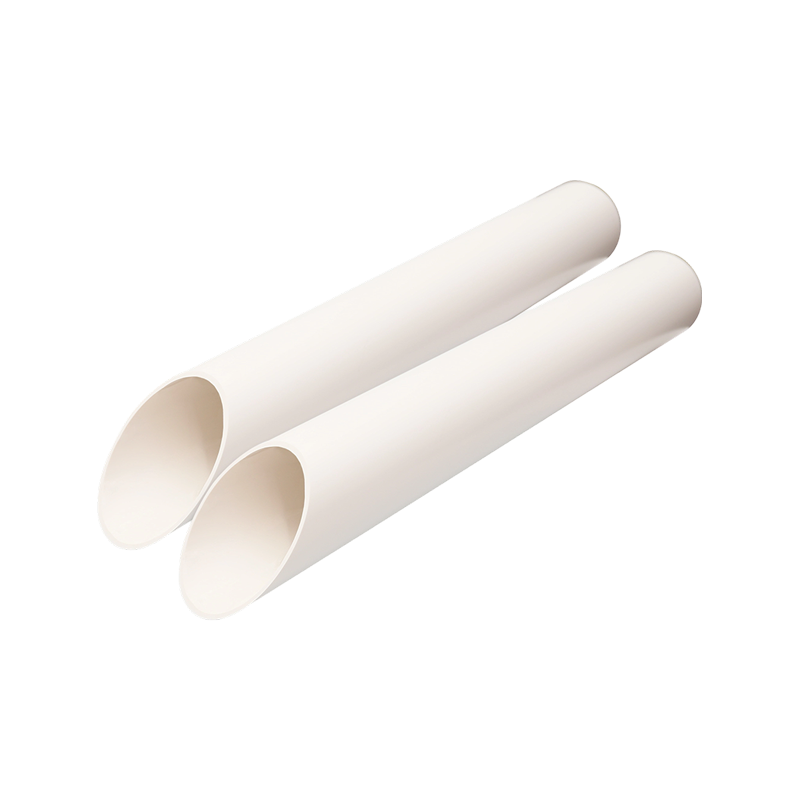 PVC Standard Drain-Pipe Suppliers, Wholesale Company - Shanghai Pilsa Pipe IndusPilsa Pipe is PVC Standard Drain-Pipe Suppliers and Company in China, Wholesale PVC Standard Drain-Pipe online, PVC Standard Drain-Pipe i...View Product →
Where the line has to follow an irregular profile, or where a heating circuit must be laid in loops, use a polyethylene pipe that takes tight radii without fittings. A PE-RT underfloor heating pipe follows the floor slab contours with the same no-flame, no-kink discipline that applies to any PE pipe.
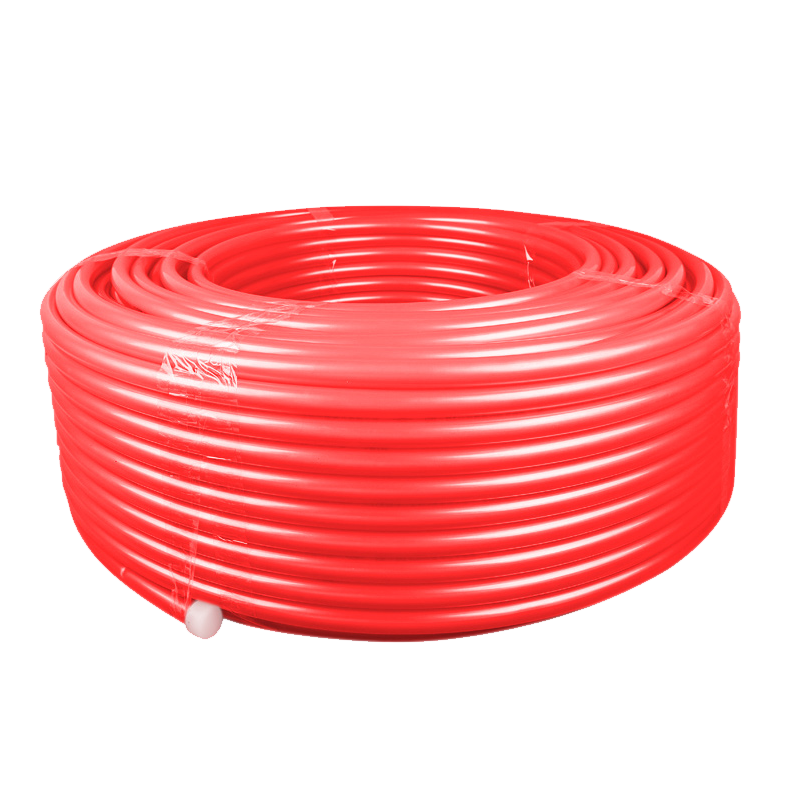 PE-RT Red Single-Layer Radiant Floor Heating Pipe Suppliers, Wholesale Company Pilsa Pipe is PE-RT Red Single-Layer Radiant Floor Heating Pipe Suppliers and Company in China, Wholesale PE-RT Red Single-Layer Radiant...View Product →
For teams buying across both material families, our plastic drainage buyer's guide on HDPE versus PVC versus PP-R compares the cost, installation, and service behavior of the three pipe types in drainage service.
What to Check When Specifying or Buying HDPE Pipe
Bend radius data should come from the same documentation as the pressure rating. Before accepting a delivery or approving a submittal, check the following points.
- Confirm the DR and the material grade. A statement of "25 times OD" implies a DR 11 pipe; a different wall thickness needs a different multiplier. The delivery document should list the DR, the standard (ISO 4427, EN 12201, or ASTM F714, depending on the market), and the minimum bend radius.
- Ask for the ovality limit used at the factory. A disciplined manufacturer measures outside diameter and wall thickness during extrusion and can state the acceptance criteria without hesitation.
- For trenchless installation, combine the bend radius with the allowable pullback tension. The drill path curvature during pullback is limited by both bending strain and axial tensile load; confirm both values before mobilization.
- Check that curved sections do not end at fusion joints. A pipe curved to force a misaligned joint together creates hidden stress; the joint fails, not the bend.
- Inspect coils and straight lengths for surface damage or stress whitening before bending. A notch or score on the outer wall concentrates strain exactly where the bend is tightest.
The bending radius of HDPE is not an obscure specification value. It is a daily installation parameter that decides whether a project buys a fitting or saves the cost of one. The 20-25 times OD rule covers the majority of jobs; thicker walls allow tighter curves, thin walls need more room, permanent bends and cold weather require extra care, and an open flame never belongs near polyethylene. Apply that simple discipline consistently, and the flexibility that makes HDPE awkward to store becomes its strongest installation advantage on the project.
Our Product //
Recommend Products
 +86-13801995968
 +86-18017886575
 No. 366, Lane 6995, Puxing Road, Fengxian District, Shanghai
Copyright © SHANGHAI PILSA PIPE INDUSTRY CO., LTD. All rights reserved.

