

 en
 English
 русский
 Español
 عربى



How Deep to Bury a Water Line: Frost Depth Rules, Codes, and Best Practices
Industry News-Content
- 1 The Rule of Thumb: Frost Depth Plus a Margin
- 2 What the Building Codes Actually Require
- 3 Factors That Move the Number Up or Down
- 4 Matching the Pipe Material to a Buried Line
- 5 Installation Details That Decide Long-Term Performance
- 6 Mistakes That Lead to Frozen or Broken Lines
- 7 Frequently Asked Questions
Ask ten installers how deep to bury a water line and you will get ten different numbers. Almost all of them, though, trace back to the same starting point: the frost line where you are building. Depth is one of the cheapest decisions on a project to get right and one of the most expensive to get wrong, because a frozen or crushed service line means excavation, downtime, and a very unhappy client.
We build pipe for a living, so we spend a lot of time on the phone with importers, contractors, and distributors asking this exact question from very different climates. The short answer is that a buried water line needs to sit below the maximum frost penetration for the site, with a safety margin added on top. Everything else, from exact inches to bedding and material choice, exists to support that one rule.
Below is the practical version: what the codes actually say, what experienced crews do in the field, and how soil, water table, and pipe material can move the number up or down.
The Rule of Thumb: Frost Depth Plus a Margin
Frost depth, sometimes called frost penetration or frost line depth, is the distance from finished grade down to the deepest point the soil is expected to freeze in a typical winter. It varies enormously: a few inches along the Gulf Coast, well over five feet in parts of Minnesota, North Dakota, and eastern Canada.
The rule of thumb most crews use is simple. Bury the water line at least 12 inches below the local frost depth, and never less than 6 inches below it. In practice, experienced installers aim for 12 inches or a little more, because published frost charts are historical averages rather than guarantees. A colder-than-average winter, a lawn left bare of snow, or a poorly compacted trench can push frost deeper than any map predicts.
Two habits are worth copying. First, measure depth to the top of the pipe rather than the centerline; inspectors vary, but top-of-pipe is the conservative reading. Second, if the trench is already open and the soil allows it, go deeper than the minimum. The extra cost of another six inches of excavation is trivial next to a service call in January.
| Region | Typical frost penetration | Common burial depth for a water service |
|---|---|---|
| Southern US, Gulf Coast | 0 to 12 inches | 18 to 24 inches |
| Mid-Atlantic, Pacific Northwest | 12 to 24 inches | 30 to 36 inches |
| Midwest, Northeast | 36 to 48 inches | 48 to 60 inches |
| Northern Plains, Canadian border | 48 to 72 inches | 60 to 84 inches |
What the Building Codes Actually Require
In the United States, the International Residential Code and the International Plumbing Code both require water service pipe to be installed below the frost line, or to be protected from freezing by another approved method. The familiar summary is "at least six inches below the frost line," and it comes with an important escape clause: unless adequate provision is made to prevent the pipe from freezing.
That clause matters in both directions. It allows insulated, heat-traced, or otherwise protected installations in shallow conditions, but it also places the burden of proof on the designer. Local amendments override the model code, and many jurisdictions publish their own minimums. In the Kansas City area, for example, water services are commonly required to sit at least 42 inches deep. Engineers in colder regions often specify four feet or more as a baseline even where the code stays silent.
Outside the United States the logic is identical, but the numbers are local. Canadian, Nordic, and northern Chinese jurisdictions frequently specify 1.5 to 2.0 meters of cover, while in warmer markets one meter or less is often entirely sufficient.
Factors That Move the Number Up or Down
Climate and Frost Penetration
Start with your local frost depth data, then adjust for exposure. Bare ground with no snow cover freezes considerably deeper than a lawn that holds an insulating snowpack all winter. A wind-scoured field or a north-facing slope deserves more cover than a sheltered courtyard in the same town.
In genuinely cold regions, material selection starts to matter as much as depth. Thermo-stabilized grades are formulated so the pipe wall keeps its impact resistance when the ground temperature drops far below freezing.
 PPR Antifreeze Pipe(1)High Temperature Resistance: the maximum sustained working temperature is up to 70 degrees Celsius, and the maximum transient temperature is up to 95 degrees Celsius.View Product →
Soil Type and Drainage
Dry, well-drained sand and gravel conduct cold far more efficiently than saturated clay, so frost penetrates deeper in sandy ground. Clay and silt hold moisture, and moist soil has a higher heat capacity, which slows the freeze front down. That is why a sandy site in a moderate climate can behave like a much colder site on paper, and why many engineers add another 6 to 12 inches of margin when the soil report comes back clean and granular.
Water Table, Bedrock, and Slope
Depth is not only about freezing. In some areas the real limit is bedrock or a high seasonal water table. A 30-inch trench that hits rock is faster and cheaper than a 60-inch trench through the same strata, which is exactly why some projects use insulation, heat trace, or an engineered protective detail instead of brute-force depth.
Grade matters too. A service line should fall continuously toward a drain point, or at minimum avoid low spots where water can collect. On a long run, a consistent slope and a properly bedded trench are worth more than a few extra inches of cover.
Matching the Pipe Material to a Buried Line
Depth protects the line from frost, but the material has to survive the installation itself. Internal pressure, thermal movement, soil load, and the occasional rock all act on a buried pipe, and the wrong choice tends to show up years later, long after the backfill is compacted.
- PPR: welded joints, good pressure and temperature performance, and no corrosion. A common choice for service lines and interior water distribution in many export markets.
- PE-RT: flexible, coilable, and widely used for underfloor heating, and useful wherever a continuous, joint-light run is preferred.
- HDPE: the default for long buried mains and trenchless installation, thanks to flexibility and excellent impact resistance.
- PEX: freeze-tolerant and easy to route, but it demands care with fittings and protection from sunlight during storage.
Whatever you specify, check the pressure rating at the service temperature you actually expect, not just at 20 C. Our PPR pipe temperature range guide explains how ratings derate as water temperature climbs, which matters on hot-water recirculation lines that share a trench with a cold service or run through the same utility corridor.
For potable water, look for pipe extruded from virgin, food-contact-grade compound rather than regrind. Our antibacterial PPR pipe carries an inner layer formulated with silver-ion technology intended to limit bacterial growth on the pipe wall, which is a sensible upgrade on potable service lines that see long residence times.
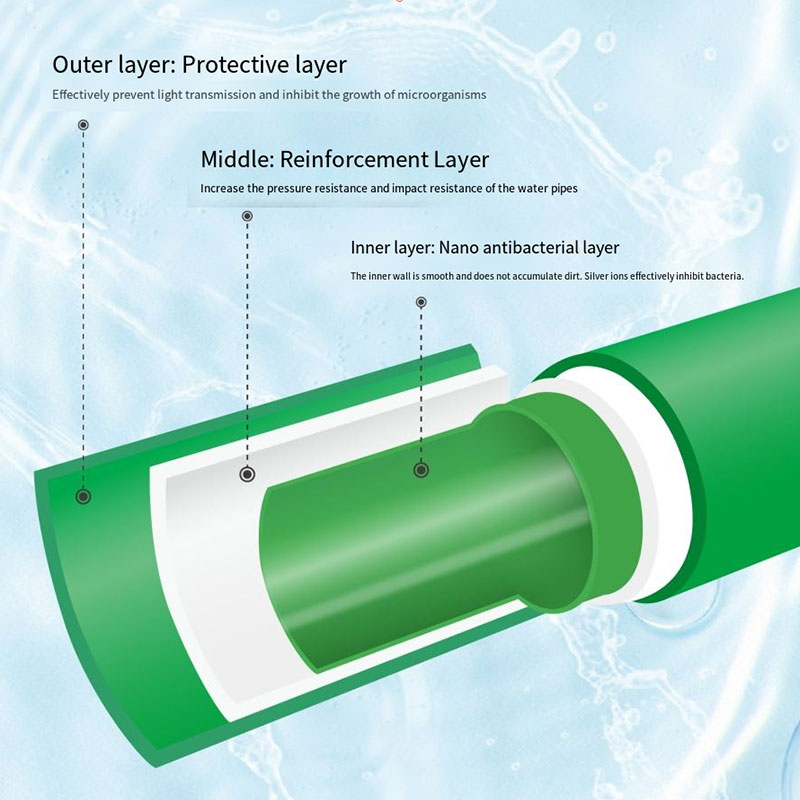 PPR Antibacterial Pipe(1)High Temperature Resistance: the maximum sustained working temperature is up to 70 degrees Celsius, and the maximum transient temperature is up to 95 degrees Celsius.View Product →
If you want to compare the whole range before specifying, the full PPR pipe range covers single-layer, double-layer, and three-layer construction, so you can match wall structure to the pressure class your project actually needs.
Installation Details That Decide Long-Term Performance
Depth alone does not protect a service line. On projects that hold up over decades, the following details are treated as non-negotiable:
- Bedding: a 4 to 6 inch sand or fine-gravel layer under the pipe shields it from sharp rock and point loading.
- Backfill: compact in lifts, and keep large stones at least 12 inches above the pipe crown.
- Tracer wire and marking tape: inexpensive insurance for whoever excavates next.
- Sleeving: where the line passes through a foundation wall or under a slab, a sleeve isolates the pipe from structural movement and leaves room for proper sealing.
- Valves: a curb stop or shut-off near the property line lets you isolate the run without digging up an entire yard.
- Pressure testing before backfill: the only free moment to repair a joint is while the trench is still open.
For the wall penetration itself, a rigid sleeve cast into the foundation keeps the pipe centered and prevents abrasion where the line enters the building.
 PVC Embedded SleeveMade from premium PVC material, it offers corrosion resistance and anti-aging properties, effectively protecting internal pipes from external environmental influences.View Product →
Mistakes That Lead to Frozen or Broken Lines
- Using a regional frost chart instead of the local one for the actual build site.
- Measuring depth to the bottom of the pipe instead of the top.
- Installing at the bare minimum in a spot that will be plowed, cleared, or left without snow cover.
- Leaving a low point in the run where water sits and freezes.
- Turning a continuous coil into a joint-heavy run for no good reason.
- Assuming a shallow line is illegal. It can be perfectly legal, but only with documented, approved freeze protection.
Frequently Asked Questions
Can I bury a water line only 12 inches deep?
Only in warm climates where frost never reaches that far, or with approved protection such as insulation, heat trace, or a protective sleeve. Across most of the United States, 12 inches is far too shallow for a potable water service.
Does insulation let me bury the line shallower?
Insulation slows heat loss, but it does not create heat. An insulated shallow line can still freeze during a sustained cold spell, particularly on a line with low or zero flow. Insulation works best when combined with depth, adequate soil cover, and sometimes an added heat source.
How deep should a water line be in sandy soil?
Deeper than the local frost chart suggests. Well-drained sand freezes faster and deeper than clay or silt, so adding 6 to 12 inches of margin on a granular site is standard practice.
Should the water line be deeper than the sewer line?
Not necessarily, but the water line should pass above the sewer line where the two cross, with the separation required by local code. Each line still has to satisfy its own depth and protection rules.
Depth is a decision you make once and live with for decades, so it is worth an hour of research before the excavator arrives. Confirm the local frost depth, add a margin, choose a pipe that suits the pressure, temperature, and soil on site, and build the trench properly. Do those four things and the line will quietly do its job long after everyone has forgotten the number.
If you are sourcing pipe and fittings for a project and want a second opinion on material selection for your climate, our technical team is glad to help. Tell us the frost depth, the soil, and the operating pressure, and we will point you toward the right system.
Our Product //
Recommend Products

 +86-13801995968
 +86-18017886575

 No. 366, Lane 6995, Puxing Road, Fengxian District, Shanghai
Copyright © SHANGHAI PILSA PIPE INDUSTRY CO., LTD. All rights reserved.

