

 en
 English
 русский
 Español
 عربى



Grey PVC Pipe Fittings: What the Color Really Tells You Before You Buy
Industry News-Content
- 1 Why Grey PVC Fittings Are a Market Code, Not a Material Grade
- 2 Where Grey PVC Pipe Fittings Are Actually Used
- 3 Grey vs White PVC: A Practical Comparison
- 4 Standards and Pressure Ratings Worth Verifying
- 5 Can You Join Grey Fittings to White Pipe?
- 6 What to Confirm Before Ordering
- 7 A Manufacturer's Perspective on Grey and Coloured PVC Fittings
- 8 Frequently Asked Questions
Grey PVC pipe fittings look almost identical to their white cousins on a shelf, yet the two are specified for very different jobs. That single shade of pigment has become shorthand for Schedule 80 pressure service in North America, for electrical conduit in many countries, and for soil-and-waste systems in others. It is also one of the most common sources of confusion we see in quotation requests: buyers ask whether grey pipe is stronger, whether it can be glued to white pipe, and whether their local inspector will accept it.
The honest answer is that colour tells you what a market expects, not what a material can do. Below is a practical look at what grey PVC fittings are, where they belong, how they compare with white PVC, and what to confirm before you place an order.
Why Grey PVC Fittings Are a Market Code, Not a Material Grade
Every PVC-U fitting starts from roughly the same base: polyvinyl chloride resin, stabilisers, lubricants, fillers and pigment. The pigment gives the finished part its colour, and that colour is selected to match a regional convention or a client's specification rather than to change the polymer itself.
In North America, grey is the familiar colour of Schedule 80 pipe and fittings, which are widely used for industrial and chemical service, and of rigid electrical conduit. White is the default for Schedule 40 drain-waste-vent systems and for potable water plumbing. In Europe, Asia and the Middle East, grey appears across soil-and-waste, rainwater and conduit systems, while white remains common for above-ground drainage. The conventions overlap, and none of them is enforced globally.
One warning matters here. Chlorinated PVC, known as CPVC, is often produced in a light grey or beige tone that looks close to grey PVC. CPVC is a different compound and needs CPVC cement, not standard PVC cement. Before you assume two fittings are interchangeable, read the print on the body: material, nominal size, schedule or standard, and any certification marks. If that information is missing, ask for the specification sheet.
Where Grey PVC Pipe Fittings Are Actually Used
Industrial and Chemical Process Lines
Grey Schedule 80 fittings are the classic industrial choice because they carry a thicker wall than Schedule 40 parts of the same nominal size. That extra material supports a higher pressure rating, adds abrasion resistance in slurry and waste lines, and gives more wall thickness to resist chemical attack. Many plants standardise on grey so that maintenance crews can distinguish a process line from a domestic water line at a glance. Socket, threaded and flanged configurations are all available, and threaded joints are common on smaller instrument and dosing lines.
Electrical Conduit and Cable Containment
Grey rigid conduit, bends, couplers, adapters, expansion fittings and junction boxes form the containment side of the market. These parts are not pressure rated at all; what matters is impact strength, resistance to flame spread, and stability under sunlight. Products are typically tested to UL 651 in the United States, to IEC or EN 61386 in Europe, or to an equivalent national standard elsewhere. Colour coding of conduit systems varies by project, so always work from the electrical specification rather than the shade of the pipe.
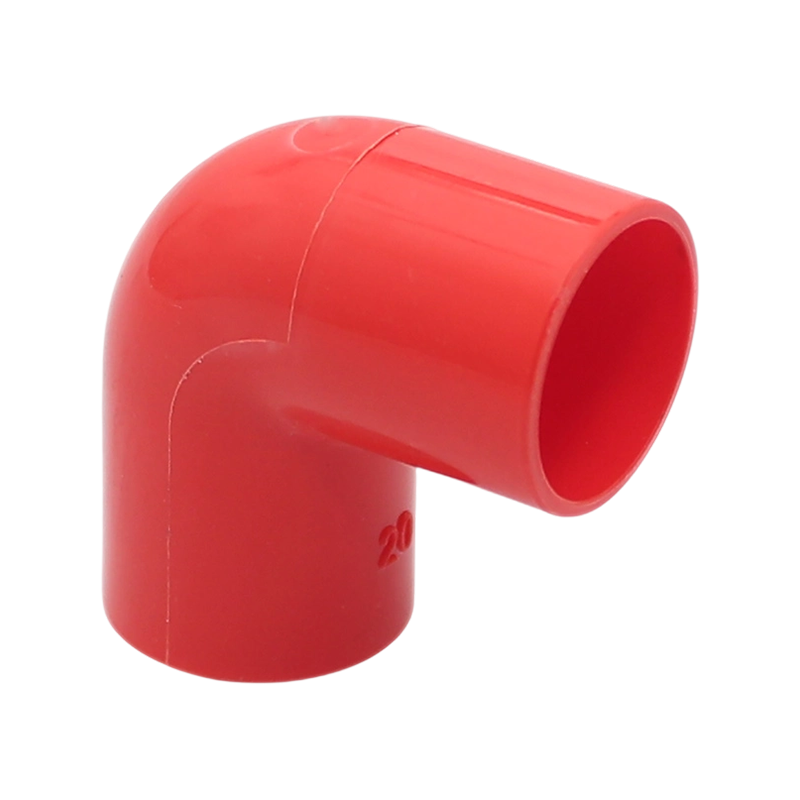 PVC Conduit Standard 90° ElbowType 215/315/415 PVC electrical conduit pipeView Product →
Drainage, Venting and Soil Stacks
Grey drainage fittings include 90-degree and 45-degree bends, Y-branches, sweep junctions, P-traps, couplings, expansion joints, cleanouts, floor drains and rainwater outlets. These parts work by gravity and are sized by nominal diameter, not by pressure class. A vent line, for example, operates at atmospheric pressure, so a drain-waste-vent fitting should never be substituted for a pressure fitting in a pumped or pressurised line, even when both are grey and look identical from the outside.
 PVC Reinforced 90° ElbowThis PVC Reinforced 90° Elbow is a high-quality accessory specifically designed for pipe systems, widely used in construction, industrial, and municipal engineering pr...View Product →
Grey vs White PVC: A Practical Comparison
The table below summarises the differences that actually affect a specification. Notice how often the answer comes back to the standard and the wall thickness rather than to the colour of the part.
| Feature | Grey PVC | White PVC |
|---|---|---|
| Common market convention | Schedule 80 industrial service, electrical conduit, soil and waste in many markets | Schedule 40 drainage, potable water plumbing |
| Typical fitting standards | ASTM D2467, ASTM D2665, UL 651 for conduit | ASTM D2466, ASTM D2665 |
| Wall thickness at equal size | Often thicker when the part is Schedule 80 | Typically thinner when the part is Schedule 40 |
| Effect of pigment on the polymer | None | None |
| UV performance | Set by additives, not colour | Set by additives, not colour |
| Joining methods | Solvent cement, threaded, gasketed | Solvent cement, threaded, gasketed |
| Code acceptance | Decided by listing and local code | Decided by listing and local code |
Standards and Pressure Ratings Worth Verifying
For pipe, the common references are ASTM D1785 for Schedule 40, 80 and 120 PVC pipe, ASTM D3034 for sewer pipe, and ISO 1452 or EN 1452 for PVC-U water supply. For fittings, look for ASTM D2466 for Schedule 40, ASTM D2467 for Schedule 80, ASTM D2665 for drain-waste-vent parts, and EN 1329 for soil and waste applications. Conduit follows UL 651, IEC 61386 or the local equivalent.
Pressure ratings depend on size, temperature and joint type. A grey Schedule 80 fitting may look robust, but its published rating falls quickly as the service temperature rises and as soon as a joint is threaded rather than solvent welded. Two practical habits keep specifications safe: confirm the rating at the actual working temperature, not at the 23 degrees Celsius reference point, and treat any threaded connection as a de-rated connection. Grey colour alone guarantees neither of those numbers.
Can You Join Grey Fittings to White Pipe?
Yes, provided both parts are PVC-U and share compatible socket dimensions. Solvent cement welds the surfaces chemically, and pigment plays no part in the bond. Problems appear in three other places: mixing PVC with CPVC, using a drain-waste-vent part in a pressure line, and pairing metric pipe with imperial fittings. Keep those three rules and the colour of the fitting becomes irrelevant.
- Cut the pipe square and check it against the socket depth marking.
- Deburr the inside and chamfer the outside edge lightly.
- Dry fit the joint to confirm alignment and mark the insertion depth.
- Apply primer where the cement manufacturer requires it.
- Apply cement to both the pipe and the socket, then push home with a quarter turn.
- Hold the joint briefly, wipe the excess bead, and allow the full cure time before pressure testing.
What to Confirm Before Ordering
- The standard and schedule required by the drawing or the local code.
- The pressure and temperature at the point of use, not at the pump outlet.
- The listing needed for the application, such as potable water approval or conduit certification.
- The size system, metric or imperial, and the socket depth.
- The joining method, and whether the cement or the gasket must also be supplied.
- Whether the fitting will be exposed to direct sunlight, and if so, what UV protection the compound offers.
- The inspection documents the project file requires, including batch and test reports.
A Manufacturer's Perspective on Grey and Coloured PVC Fittings
Suban, the export brand of Shanghai Pilsa Pipe Industry Co., Ltd., has been producing plastic piping systems since 2003, with manufacturing bases in Shanghai and Zhoukou and export experience across more than twenty countries. Our PVC-U drainage range covers bends, branches, couplings, expansion joints, cleanouts, traps, floor drains and rainwater outlets, while our electrical range covers conduit, bends and junction boxes. Because we mould the fittings ourselves, colour, wall thickness and socket dimensions are set at the tooling and compound stage rather than bought in from a third party.
If you are comparing families of material before you narrow down the fitting, our overview of PVC-U, CPVC and PVCO pipe types explains where each compound belongs. For containment projects, the PVC electrical conduit and junction box range lists the bends, boxes and accessories that ship together. Send us the drawing, the standard and the colour requirement, and we will quote against them.
 PVC Expansion JointPVC Expansion Joint is specifically designed to address thermal expansion and contraction issues in piping systems, effectively absorbing displacement and vibration ca...View Product →
Frequently Asked Questions
Are grey PVC fittings stronger than white ones?
Not because of the colour. A grey Schedule 80 fitting is stronger than a white Schedule 40 fitting of the same size because it has a thicker wall. A grey Schedule 40 part and a white Schedule 40 part perform the same.
Can grey PVC be used for drinking water?
Colour does not disqualify a fitting, and colour does not approve one either. Potable water service depends on the compound formulation and on a listing such as NSF or the relevant national approval. Check the certificate, not the shade.
Will grey fittings fade or crack outdoors?
Sunlight affects all PVC grades, and colour offers no protection on its own. Formulations with suitable UV additives last far longer than unprotected parts. Where appearance matters, shade the line or coat the exposed section.
Do grey fittings need a special cement?
No. Standard PVC solvent cement works on grey and white PVC alike, as long as both parts are PVC rather than CPVC and the cure time suits the pipe diameter and the ambient temperature.
Grey PVC pipe fittings are a useful shorthand in a market that has agreed on certain conventions, but they are not a shortcut through a specification. Confirm the schedule, the standard, the listing and the joint type, and the colour becomes exactly what it should be: a helpful visual cue on site, and nothing more.
Our Product //
Recommend Products


 +86-13801995968
 +86-18017886575

 No. 366, Lane 6995, Puxing Road, Fengxian District, Shanghai
Copyright © SHANGHAI PILSA PIPE INDUSTRY CO., LTD. All rights reserved.

