

 en
 English
 русский
 Español
 عربى



HDPE Material Properties Explained: Density, Strength and Pipe Selection
Industry News-Content
High-density polyethylene has a simple reputation: a tough, waxy plastic that ignores most chemicals and quietly survives fifty years underground. That reputation is earned, but it hides a lot of detail. Two pipes can carry the same HDPE label and still behave quite differently once they are in the trench, because density, molecular weight, comonomer type and additive package all pull the material's properties in different directions.
We have been manufacturing thermoplastic pipe in Shanghai since 2003, and the questions we receive about HDPE material properties usually come from buyers who need to make a decision rather than pass an exam. This guide sticks to the numbers that genuinely change how a pipe performs, how it is joined and how long it lasts.
What "High Density" Means at the Molecular Level
Polyethylene is a chain of repeating CH2 units, and what separates one polyethylene from another is how those chains are built. HDPE is polymerised with Ziegler-Natta or metallocene catalysts that produce long, almost linear chains with very few side branches. Straight chains pack tightly and crystallise readily, so HDPE reaches a crystallinity of roughly 70 to 80 percent and a density between 0.941 and 0.965 g/cm3. LDPE is full of long-chain branching, so its chains cannot pack as closely; it settles around 0.910 to 0.925 g/cm3 and feels noticeably softer.
For pipe applications, three variables do most of the work:
- Density: higher density raises stiffness, tensile strength and barrier performance, but reduces flexibility and low-temperature impact resistance.
- Molecular weight and melt flow rate: a higher molecular weight brings better toughness and environmental stress crack resistance, at the cost of harder extrusion.
- Comonomer type: butene, hexene and octene comonomers interrupt crystallisation in a controlled way, which is how modern PE100 and PE100-RC grades resist slow crack growth so well.
These variables are why the industry talks in grade classes. PE63, PE80 and PE100 refer to minimum required strength values of 6.3, 8.0 and 10.0 MPa at 20 C over 50 years, not to three different polymers.
Core Physical and Mechanical Properties
Published data sheets vary because they describe different grades, but the ranges below are representative of pipe-grade HDPE. They are the figures we check first when comparing compounds from different suppliers.
| Property | Typical range | What it means in practice |
|---|---|---|
| Density | 0.941-0.965 g/cm3 | Sets stiffness, weight and buoyancy in wet trenches |
| Melting point | 125-135 C | Defines the fusion joining window, not a service temperature |
| Tensile strength at yield | 20-30 MPa | Resistance to internal pressure and soil load |
| Elongation at break | over 600% | Ductility: the pipe deforms long before it fractures |
| Flexural modulus | 800-1,200 MPa | Ring stiffness and deflection under backfill |
| Notched impact, 23 C | 20 kJ/m2 or no break | Survives rough handling and cold-weather installation |
| Water absorption, 24 h | below 0.01% | No swelling, stable dimensions in wet service |
| Thermal conductivity | about 0.4 W/m*K | Low heat loss in buried hot water lines |
| Linear thermal expansion | 1.2-1.8 x 10⁻⁴ per K | Drives expansion loops, anchors and offsets |
| Continuous service temperature | -40 to 60 C | Pressure derating required above 20 C |
| Volume resistivity | above 10^16 ohm*cm | Electrical insulation, no galvanic corrosion |
Chemical Resistance, Weathering and Long-Term Behaviour
HDPE is chemically inert against most of what it meets underground. It handles dilute and concentrated acids, alkalis, salt solutions and alcohols, and it does not corrode, scale or take part in galvanic reactions. It is not universal, though. Strong oxidising acids attack it, and hydrocarbons and chlorinated solvents cause swelling and permeation, a point that matters when a line runs through contaminated ground or carries industrial effluent.
Sunlight is the other weak spot. Unstabilised polyethylene embrittles under UV, which is why pipe compounds contain 2 to 2.5 percent well-dispersed carbon black or an equivalent UV package. Black pipe tolerates months of outdoor storage; natural-coloured pipe does not.
Biological attack is rarely a concern, since neither fungi nor bacteria use polyethylene as a food source. Long-term performance is instead governed by slow crack growth and environmental stress crack resistance, both assessed through hydrostatic stress regression testing to ISO 9080 and extrapolated to a 50-year design life. That extrapolation is where the MRS figure behind every PE grade comes from.
Density, Melt Index, SDR and Pressure Rating
Wall thickness is the other half of the story. Pressure pipe is specified by SDR, or DR, the ratio of outside diameter to wall thickness. A lower SDR means a thicker wall and a higher pressure rating: for PE100 water pipe, SDR 11 corresponds to PN16 at 20 C, while SDR 17 sits near PN10. The relationship is not linear with temperature, and most grades must be derated above 20 C. Our technical note on HDPE DR 11 pipe walks through the wall thickness maths and the selection steps in more detail.
Melt index influences processing more than pressure rating. A higher melt flow rate extrudes faster and fuses more easily, but grades with a very high flow rate tend to offer lower stress crack resistance. For mains and critical drainage, low melt index, high molecular weight compounds remain the safer choice.
HDPE is not the only polyethylene we work with. Where pipes have to carry warm water, such as underfloor heating circuits, standard HDPE runs out of temperature headroom and a raised-temperature polyethylene takes over. PE-RT is the grade most often specified for those loops, because it keeps a stable pressure rating at 70 C while staying flexible enough to bend by hand.
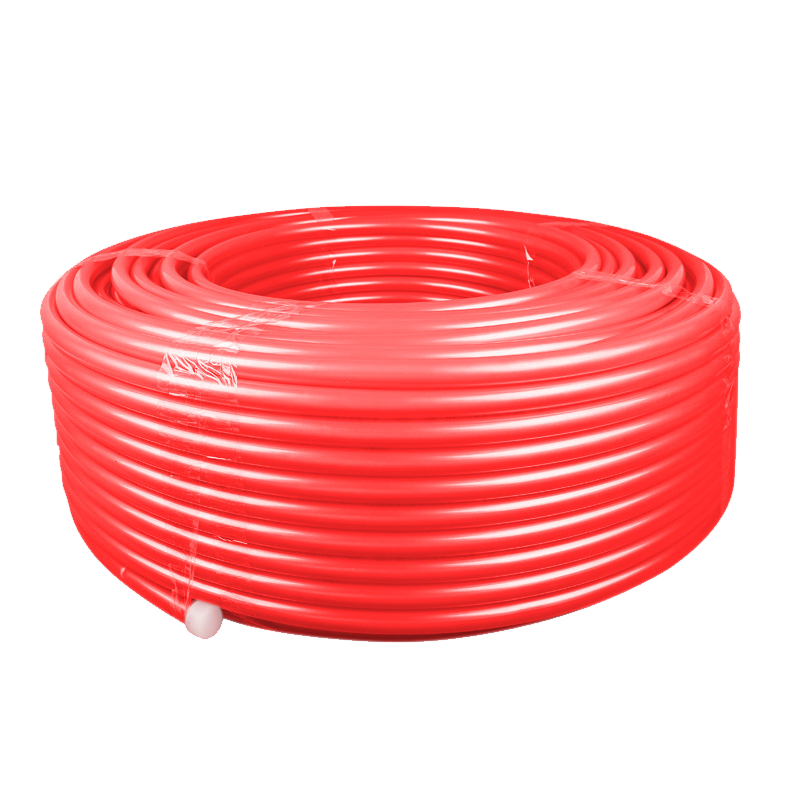 PE-RT Red Single-Layer Radiant Floor Heating PipeA red single-layer PE-RT option for radiant floor heating loops, shown within a broader PE-RT underfloor heating pipe range for warm-water installations.View Product →
How HDPE Compares With PVC and PPR
Buyers rarely choose a material in isolation; they compare it with the alternatives already on the drawing.
- HDPE against PVC-U: PVC is stiffer and often cheaper per metre in drainage sizes, and solvent cement joints go together quickly. HDPE is tougher, tolerates settlement and vibration, and can be fused into joints as strong as the pipe wall itself.
- HDPE against PPR: both are polyolefins and both are heat fused, but PPR holds its pressure rating at 70 C, which makes it the natural choice for domestic hot and cold water inside buildings. HDPE is usually better for cold water mains, sewage and industrial lines, where diameter, run length and abrasion resistance matter more than temperature.
- HDPE against metal: lighter, immune to galvanic corrosion and far more abrasion resistant in slurry service, but it needs closer support at elevated temperatures and expands roughly ten times as much as steel.
On the drainage side of our own range, PVC-U remains the workhorse for in-building soil and waste stacks.
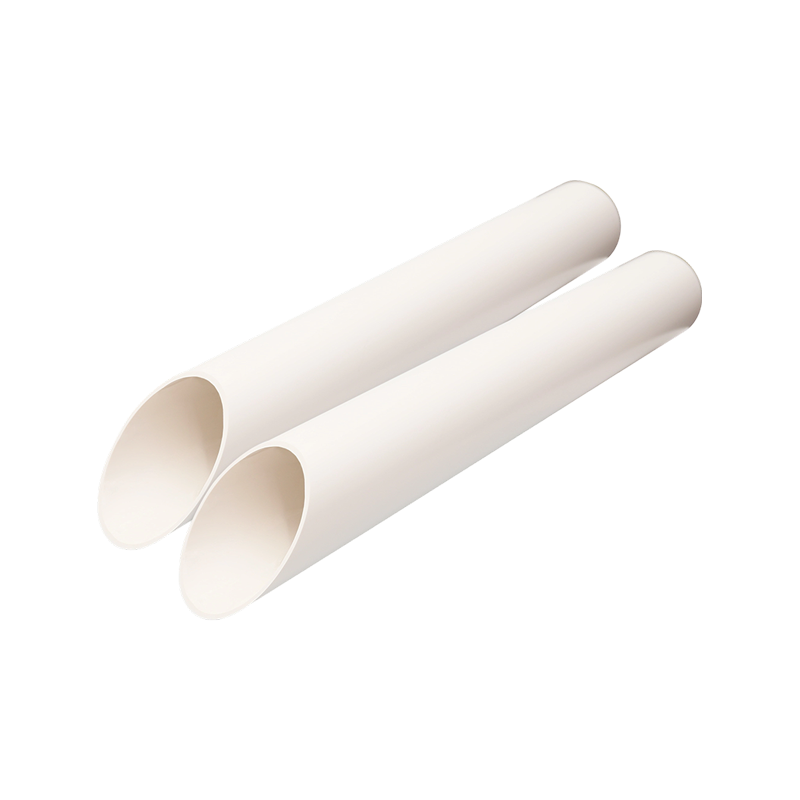 PVC Standard Drain-Pipe for Stormwater and Wastewater SystemsPVC drainage pipe in 40–315 mm diameters and 4 m lengths, suited to stormwater, wastewater, and underground drainage where durable, smooth-flowing performance matters.View Product →
What These Properties Mean on Site
Data sheet values only become useful once they are translated into installation practice. These are the rules we repeat to project teams:
- Allow for thermal movement. At about 1.5 x 10⁻⁴ per K, a 50 m run moves roughly 75 mm across a 10 C swing, so anchors, loops and offsets are not optional.
- Respect the bending radius. Cold bending is normally limited to 20 to 25 times the outside diameter; anything tighter needs a fitting.
- Control the fusion process. Butt fusion and electrofusion give the strongest joints, but only with calibrated equipment, correct heating times and clean, square pipe ends.
- Plan for UV exposure. Black pipe can stay outdoors for months; unpigmented pipe needs covering.
- Backfill with care. HDPE deflects rather than cracks, so the surrounding soil becomes part of the structure, and bedding quality decides long-term ring performance.
Questions We Hear Most
Is HDPE safe for drinking water?
Yes. Pipe-grade HDPE contains no plasticisers or heavy metal stabilisers, and compounds intended for potable water are tested for taste, odour and migration under the relevant national and international standards.
What temperature can HDPE pipe handle?
Around 60 C continuously for standard grades, with short excursions to 80 C. Above 20 C the pressure rating must be derated, which is why hot water lines usually move to PPR or PE-RT.
Is PE100 the same as HDPE?
PE100 is a grade class within HDPE, defined by a 50-year minimum required strength of 10 MPa. Not every HDPE compound qualifies, which is why the grade name belongs on the specification.
HDPE material properties come down to a set of trade-offs, and a good supplier should be able to explain in plain language which numbers matter for your project and which are marketing. If you are comparing grades, writing a specification or simply unsure whether HDPE, PPR or PVC belongs on a particular line, our technical team is glad to look at the drawing with you. Send us your project details and we will come back with a straight answer.
Our Product //
Recommend Products

 +86-13801995968
 +86-18017886575

 No. 366, Lane 6995, Puxing Road, Fengxian District, Shanghai
Copyright © SHANGHAI PILSA PIPE INDUSTRY CO., LTD. All rights reserved.

