

 en
 English
 русский
 Español
 عربى



Bending vs Angled Fittings: Choosing the Right Pipe Route in PPR and PVC
Industry News-Content
- 1 What bending and angled fittings actually mean in practice
- 2 Where a bend has the edge
- 3 When angled fittings are the better choice
- 4 Material-by-material: PPR, PVC, PE-RT, and conduit
- 5 A practical comparison by system
- 6 Pressure loss, leak paths, and the cost of rework
- 7 A quick selection checklist
- 8 A practical bottom line
Bending vs angled fittings is one of those choices that looks simple on a drawing and becomes more interesting on site. A bend is a curve formed in the pipe itself; an angled fitting is a factory-made elbow, usually 45° or 90°, joined to the pipe. Both change direction, but they do it with different tools, different risk profiles, and different long-term consequences. The right answer depends less on preference than on pipe material, available space, joint method, flow requirements, and how the line will be tested and maintained.
What bending and angled fittings actually mean in practice
In plumbing, heating, and electrical work, “bending” can mean field bending with a spring, bender, or controlled heat. It can also mean a factory-made sweep bend with a larger radius. An angled fitting is a discrete component with sockets, spigots, or threaded ends that connects two pipe lengths at a set angle. The distinction matters because a bend removes a joint, while a fitting adds one.
Material rules decide most of the argument. PPR water pipe is normally joined by heat fusion, and field bending is not a standard substitute for a molded elbow. PVC drainage pipe is usually solvent-welded using fittings. PVC electrical conduit is often field-bent with a spring or bender. PE-RT underfloor heating pipe is flexible enough to curve around obstacles within its minimum bend radius. Treating these systems as if they behave the same way is where installation problems begin.
Where a bend has the edge
A well-formed bend usually wins on flow and leak potential. A smooth curve creates less local resistance than a tight 90° elbow, and it removes two fusion or solvent-weld joints from the run. Fewer joints mean fewer places for a weak weld, a dry socket, or a future drip. On long runs, that can also mean a lower pressure loss and a tidier appearance, especially where pipework is exposed.
Bends are also useful where fittings would crowd a space. A sweep can carry a line around a structural beam or through a plant room without a chain of elbows. However, a bend is only an advantage when the pipe can take the curve without kinking, ovalizing, or thinning at the outer wall. Minimum bend radius, wall thickness, and the manufacturer’s instructions are not optional details. A poor bend is worse than a good fitting because the defect may be hidden inside the curve.
When angled fittings are the better choice
Angled fittings bring repeatability. A molded 45° or 90° elbow has known dimensions, a controlled socket depth, and a shape that can be checked before installation. That matters in PPR hot-water lines, PVC drainage stacks, and any concealed pipework where a failed joint is expensive to reach. Fittings also make it easier to connect to valves, manifolds, traps, cleanouts, and equipment without improvising a bend on site.
Tight corners favor fittings. So do repairs and future service. If a line may need to be opened, a fitting with a cleanout or a union is more practical than a permanent bend. Field bending also demands skill and the right tool; a rushed bend in PVC conduit can kink, and overheated PPR can lose wall strength. For many contractors, the most reliable choice is the one that can be inspected, tested, and repeated by the whole crew.
Material-by-material: PPR, PVC, PE-RT, and conduit
PPR water supply
PPR is a heat-fusion system. In domestic and commercial water lines, a molded elbow is usually more reliable than a field-made bend because the joint is controlled and can be pressure-tested. Use fittings for standard 90° and 45° changes, and reserve bending for situations where the pipe manufacturer explicitly allows it and the radius is generous. Socket depth, heating time, and alignment matter more than speed. For a deeper look at fitting types and pressure ratings, see this PPR pipe fittings guide.
 PPR D25 90 Degree Hot-Melt ElbowA molded 90° PPR fitting for heat-fused water-supply pipework, suited to predictable direction changes in concealed hot and cold routes.View Product →
A standard 90° elbow is a practical starting point for many concealed hot and cold water routes. It keeps the run predictable and gives the installer a clean fusion joint at each end.
PVC drainage
PVC drainage is not a field-bending system in normal practice. Solvent-weld elbows, sweep bends, and P-traps are used to make changes in direction while maintaining socket strength and smooth internal flow. A long-radius sweep may be preferred on a soil stack, but it is still a manufactured fitting, not a heated pipe bend. Cleanouts and inspection openings should be planned before the line is glued, not after.
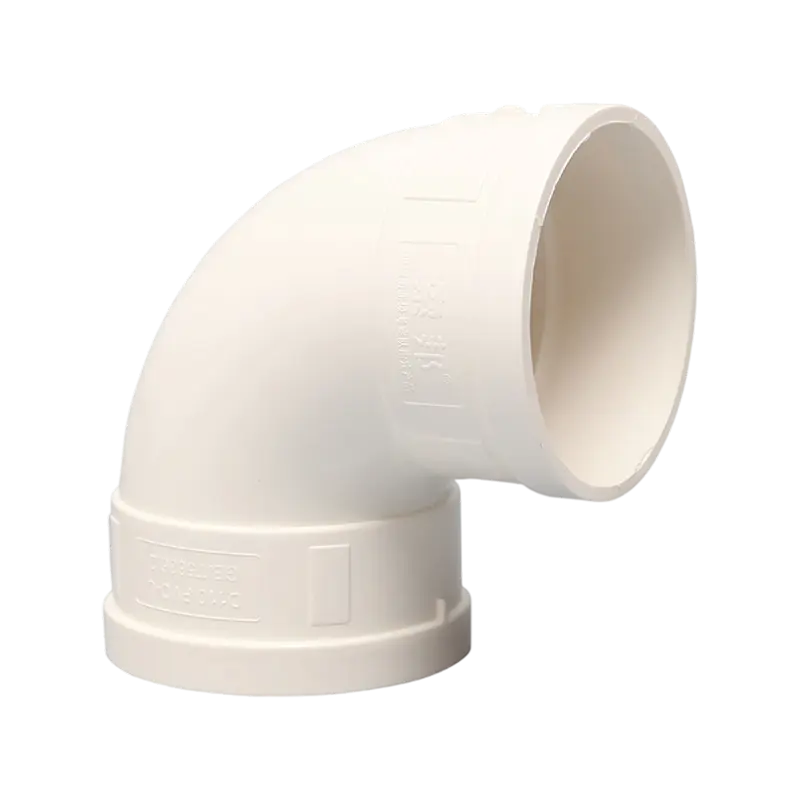 90° PVC Solvent-Weld Drainage ElbowA PVC 90° fitting for drainage layouts, available from D50 to D315, with a smooth interior for directional changes in solvent-welded pipe runs.View Product →
A 90° PVC elbow is common at stack connections, branch turns, and tight ceiling voids. Match the fitting to the pipe diameter and use the correct solvent cement procedure for a sound joint.
PVC electrical conduit
Electrical conduit is the clearest case for field bending. A spring or bender can produce a smooth curve that pulls cable easily and reduces the number of couplings. The bend must not kink, flatten, or reduce the internal diameter. Where a factory elbow is preferred, a molded conduit elbow keeps the run neat and consistent, especially at panel entries and exposed corners.
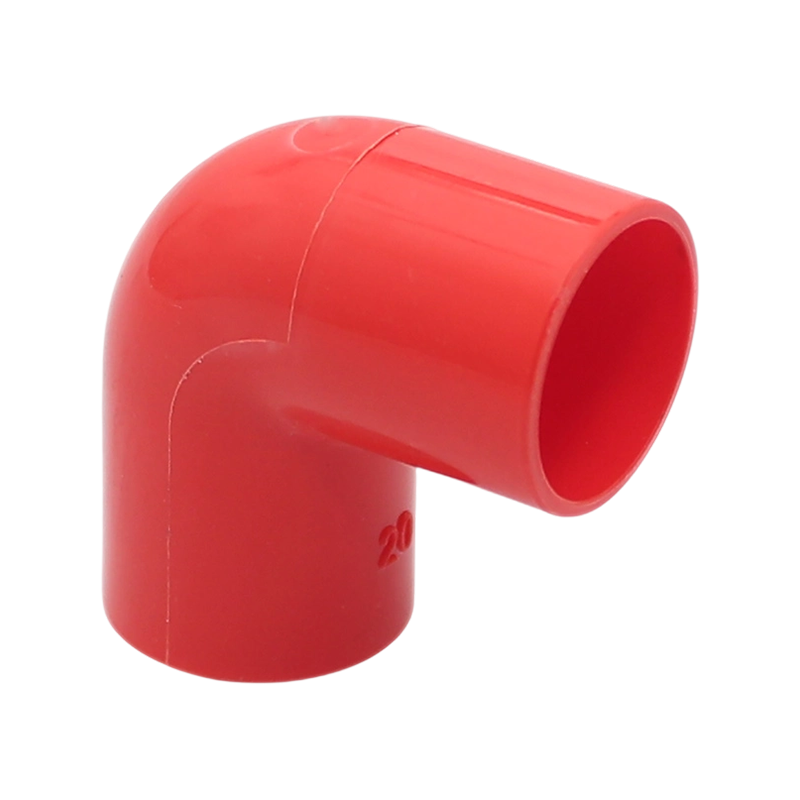 PVC Conduit Standard 90° ElbowA factory-made PVC conduit elbow for neat 90° changes where a field bend is awkward, such as panel entries and exposed corners.View Product →
A PVC conduit 90° elbow is useful where a field bend would be awkward, such as a short offset near a box or a change of direction close to a wall.
PE-RT underfloor heating
PE-RT heating pipe is designed to curve. Bending is normal inside floor loops, provided the minimum radius is respected and the pipe is not stressed at the manifold. Angled fittings are mainly needed at terminations, manifold connections, and places where the pipe must turn sharply outside its safe bend radius. Keep bends gentle and support the pipe so it does not spring back or rub against a sharp edge.
A practical comparison by system
| System | Field bending practical? | Common angled fitting | Where it makes sense |
|---|---|---|---|
| PPR water supply | Rarely; heat-fusion fittings are standard | 45° and 90° elbows, tees, unions | Concealed hot and cold lines, plant rooms, fixture connections |
| PVC drainage | Not normal for DWV work | 45° and 90° elbows, sweeps, P-traps | Stack connections, branch turns, tight ceiling voids |
| PVC electrical conduit | Common with a spring or bender | 90° elbows, couplings, junction boxes | Exposed runs, panel entries, short offsets near boxes |
| PE-RT heating pipe | Normal within the minimum bend radius | Manifold connections and termination elbows | Floor loops, curves around obstacles, manifold tails |
Pressure loss, leak paths, and the cost of rework
Every change of direction adds local resistance. A long-radius bend generally has lower pressure loss than a tight 90° elbow, and a pair of 45° fittings can sometimes approximate a sweep. But each additional fitting adds a joint, a material cost, and another place where the installation can go wrong. In small domestic systems, the flow difference may be minor. In larger heating, chilled-water, or process lines, it can affect pump selection and energy use.
Leak risk is the more immediate concern. A fusion or solvent-weld joint is only as good as its preparation. A bend removes joints, but a bad bend can create a thin outer wall or a restriction that is difficult to see. The safest approach is to use the method the pipe system was designed for, then test it properly. For PPR, that means correct heating time and insertion depth. For PVC, it means clean surfaces, proper cement, and enough cure time before pressure testing. For conduit, it means a bend that still allows the cable to pull freely.
A quick selection checklist
- Confirm that the pipe material and local code allow field bending for the application.
- Check the minimum bend radius, wall thickness, and any manufacturer limits before making the curve.
- Count the joints. Fewer joints can reduce leak paths, but only if the bend is formed correctly.
- Use angled fittings where dimensions must be repeatable, space is tight, or the line needs a cleanout or union.
- Plan testing and access. A concealed joint should be worth its convenience.
- Match the fitting to the pipe system, diameter, and join method rather than forcing a generic part.
A practical bottom line
Bending vs angled fittings is not a contest with one universal winner. For PVC conduit and PE-RT heating loops, bending is often the natural choice. For PPR water lines and PVC drainage, factory-made elbows are usually the safer and more repeatable solution. The best installations use bends where the pipe can take them cleanly and fittings where control, access, and testability matter more than saving a joint.
At Suban, we supply PPR, PVC, and PE-RT pipes and fittings for water supply, drainage, electrical conduit, and underfloor heating systems. If you are weighing bending against angled fittings for a project, talk to our technical team with your pipe size, application, and layout, and we can help you choose a practical route.
Our Product //
Recommend Products
 +86-13801995968
 +86-18017886575

 No. 366, Lane 6995, Puxing Road, Fengxian District, Shanghai
Copyright © SHANGHAI PILSA PIPE INDUSTRY CO., LTD. All rights reserved.

