

 en
en
 English
 русский
 Español
 عربى
عربى


PPR Pipe Fittings: Types, Pressure Ratings & How to Choose the Right One
Industry News-Content
What Are PPR Pipe Fittings?
A piping system is only as reliable as its weakest connection point. That's where PPR pipe fittings come in. Made from Polypropylene Random Copolymer (PPR) — the same thermoplastic material used in the pipes themselves — these fittings serve as the structural joints that allow a piping network to change direction, split into branches, transition between sizes, and connect to equipment or valves.
Unlike metal fittings that can corrode over time, PPR fittings form a permanent molecular bond with the pipe through heat fusion welding. The connection point actually becomes stronger than the pipe wall itself, which is why PPR systems are increasingly specified for both residential and commercial installations worldwide. To understand more about the base material, see our guide on material properties and applications of PPR pipe, and explore our PPR pipes for water supply systems to pair with the right fittings from the start.
Key Advantages of PPR Pipe Fittings
The reason PPR fittings have displaced copper and galvanized steel in so many projects comes down to a combination of performance characteristics that metal simply cannot match at the same price point.
- High temperature resistance: PPR fittings maintain structural integrity at sustained operating temperatures up to 95°C (203°F), making them fully compatible with domestic hot water and low-temperature heating circuits.
- Exceptional service life: Under standard operating conditions (70°C, 10 bar), PPR systems are rated for a minimum service life of 50 years — a figure backed by long-term pressure testing under ISO 9080.
- Chemical and corrosion resistance: The polypropylene matrix resists attack from acids, alkalis, and most industrial solvents. There is no rust, no scale build-up, and no electrochemical corrosion at transitions.
- Low friction, smooth bore: The smooth inner surface of PPR fittings produces minimal turbulence and head loss, supporting efficient flow rates even in long or complex pipe runs.
- Non-toxic and food-safe: PPR does not leach plasticizers or heavy metals, making it suitable for drinking water conveyance without additional lining or treatment.
- Lightweight and easy to handle: PPR fittings weigh roughly one-eighth of equivalent copper fittings, reducing installation labor and lowering structural loads in building applications.
Types of PPR Pipe Fittings and Their Functions
Every function in a piping layout — direction change, branching, diameter reduction, connection to valves or threaded equipment — has a dedicated PPR fitting designed for it. Here is a breakdown of the most common types and when each one is used.
Elbows (45° and 90°)
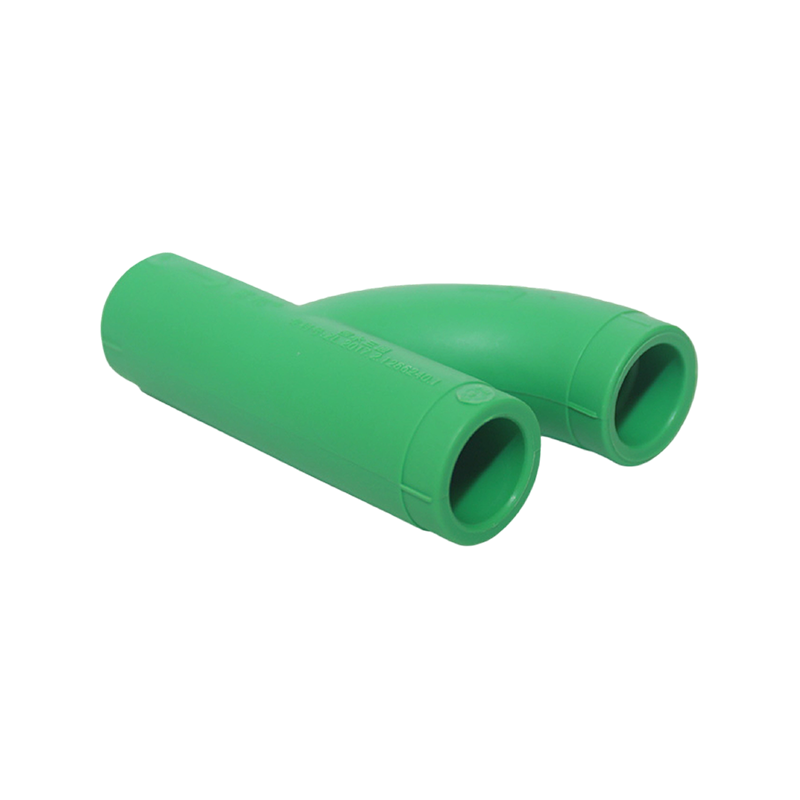
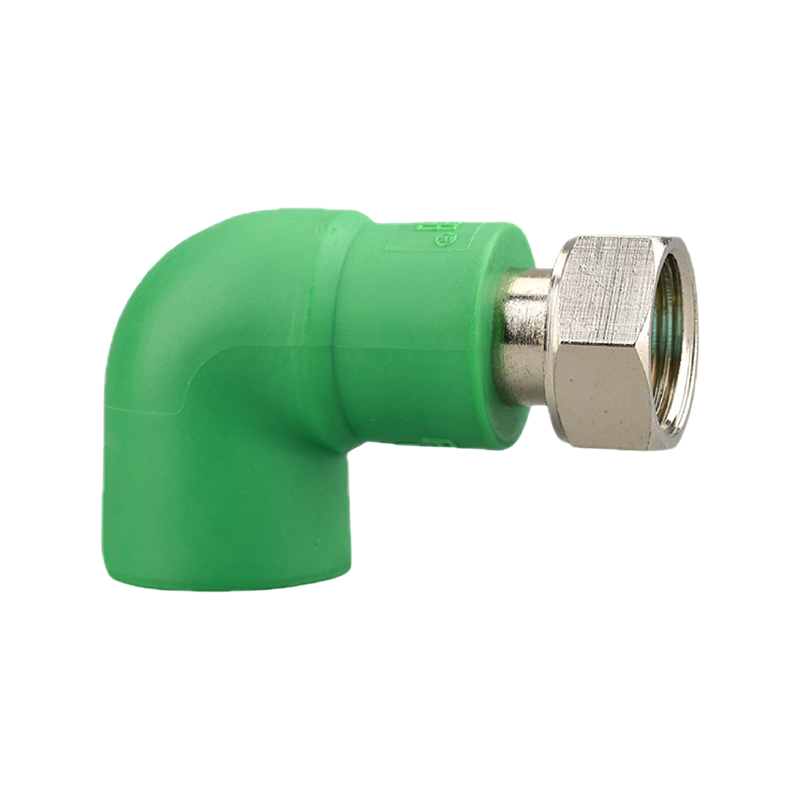
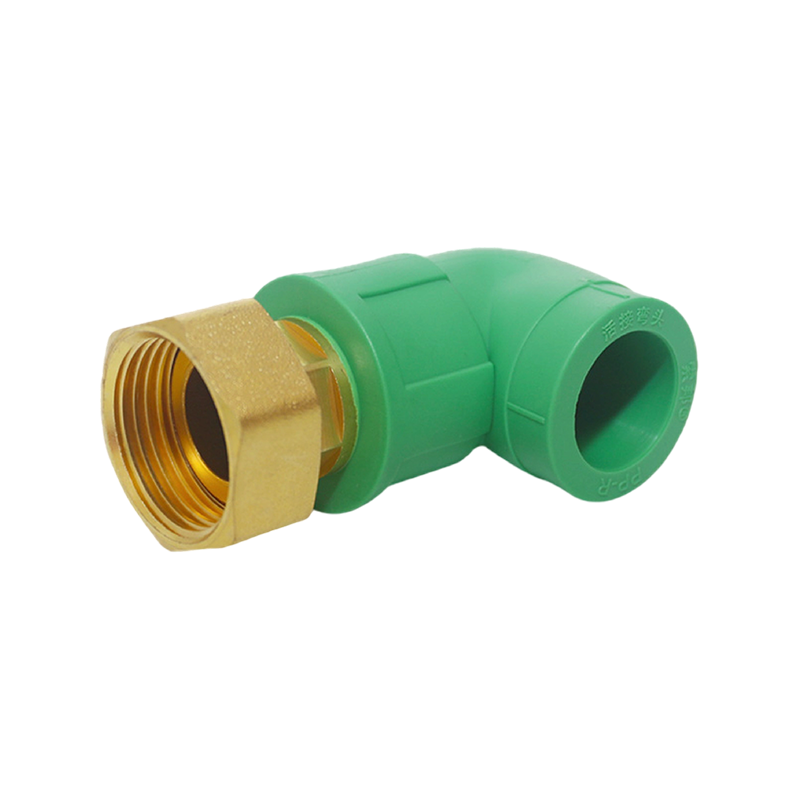
Elbows redirect the pipe run at a fixed angle. The 90° elbow is the most commonly installed fitting in any plumbing system, used wherever a pipeline turns a corner. The 45° elbow is preferred when a gradual directional shift is needed to reduce flow turbulence or fit a sloped installation. Browse our elbows for directional changes in hot and cold water lines for available sizes and configurations.
Tees (Equal and Reducing)
Tee fittings branch one pipe into two directions, or merge two flows into one. An equal tee connects three pipes of the same diameter; a reducing tee accommodates a smaller branch off a larger main line. They are the backbone of any distribution network. See our full selection of tee fittings for branching water supply lines.
Couplings
Couplings join two pipes of the same diameter end-to-end in a straight line. They are used to extend a run, splice a repair section, or connect pipe lengths where no directional change is required. Reducing couplings serve the same function between pipes of different diameters.
Unions
Unlike a standard coupling, a union can be disassembled without cutting the pipe. This makes unions the fitting of choice at connection points that require periodic maintenance access — pump inlets, meter stations, or filter housings. Our unions for easy disconnection and maintenance are available in both all-plastic and brass-insert configurations.
Adapters (Male and Female Threaded)
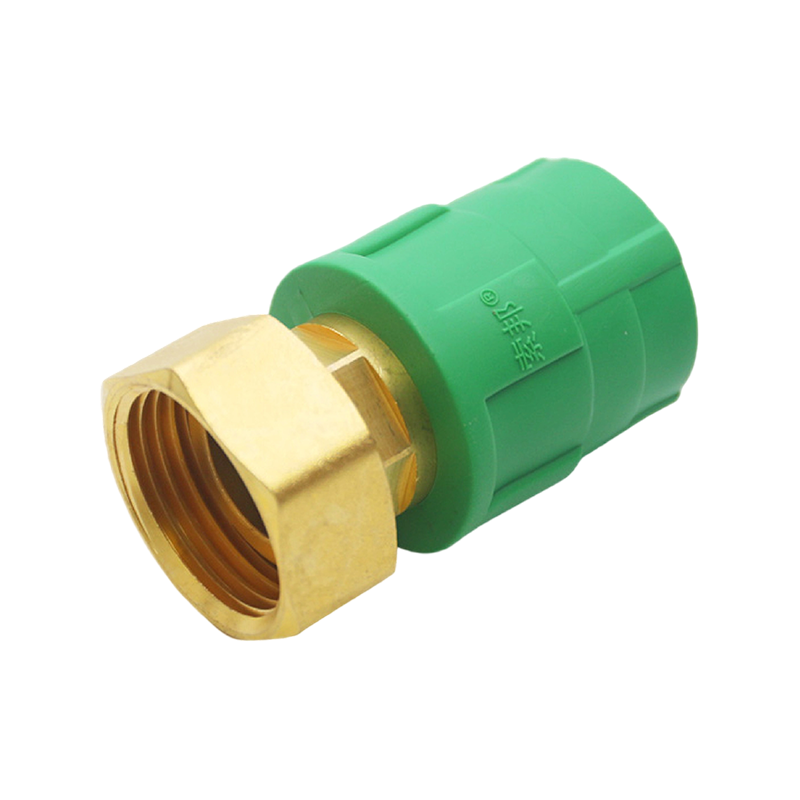
Threaded adapters create a transition between the heat-fusion PPR world and any threaded metal or plastic component — valves, meters, boiler connections, or faucet bodies. One end is fused to the PPR pipe; the other carries an ISO-standard male or female thread.
Reducers
Reducers connect pipes of different diameters in a straight run, stepping down from a larger main to a smaller branch or service line. They are used extensively in distribution systems where flow is divided progressively across a building floor plan.
End Caps
Caps seal the open end of a pipe, either permanently closing a line or temporarily capping it during pressure testing. They are heat-fused directly onto the pipe end and provide a fully sealed termination.
Ball Valves and Stop Valves
PPR ball valves allow full-bore on/off control within a PPR system without transitioning to metal. PPR stop valves offer pressure regulation or zone isolation for maintenance. Both integrate via heat fusion on the pipe side and are specified wherever manual flow control is needed.
PPR Fittings Pressure Ratings Explained (PN16, PN20, PN25)
The "PN" designation stands for Pressure Nominal and indicates the maximum allowable operating pressure in bar at 20°C. Selecting the correct PN class for the operating temperature and pressure in your system is the single most important specification decision when sourcing PPR fittings.
| PN Rating | Max Pressure at 20°C | Max Continuous Temp | Typical Application |
|---|---|---|---|
| PN16 | 16 bar | 60°C | Cold water supply, low-pressure irrigation |
| PN20 | 20 bar | 70°C | Hot and cold domestic water, standard HVAC |
| PN25 | 25 bar | 95°C | High-temperature heating, industrial process lines |
A practical rule: as operating temperature rises, the safe working pressure drops. A PN20 fitting rated at 20 bar at 20°C carries approximately 3.5 bar safely at a sustained 70°C. Always consult the manufacturer's derating curves when designing systems that operate near or above 60°C for extended periods.
Common Applications Across Industries
The combination of temperature resistance, chemical inertness, and hygienic properties makes PPR fittings the default choice across a wide range of sectors. Browse our our full range of PPR pipe fittings to find products matched to each of the applications below.
Residential Plumbing
PPR fittings are the standard connection method for hot and cold domestic water in apartments and houses. The leak-free fusion joints eliminate the joint failures common in compression fittings over time, and the non-toxic material requires no special approvals for drinking water service.
Commercial Buildings
Hotels, hospitals, and office towers rely on PPR for their central hot water distribution loops, chilled water circuits, and compressed air lines. The lightweight pipe and fittings reduce installation time significantly on multi-floor projects, and the long service life keeps lifecycle maintenance costs low.
Industrial Process Lines
Chemical plants, food processing facilities, and pharmaceutical manufacturers use PPR fittings to convey dilute acids, alkalis, and purified water. The smooth bore prevents bacterial adhesion in sanitary applications, and the chemical resistance profile covers most process fluids encountered in light industrial settings.
Heating Systems
PPR is widely used in underfloor radiant heating loops and low-temperature radiator circuits. The material's low thermal conductivity helps maintain fluid temperature between the heat source and the delivery points, and PN25-rated fittings handle the elevated pressure and temperature conditions typical of boiler-fed systems.
International Standards and What to Check When Buying
Not all PPR fittings on the market are manufactured to the same quality level. The difference between a compliant fitting and a substandard one may not be visible at installation — it shows up as a premature failure under pressure or temperature cycling. Knowing which standards to look for protects your project.
Key Standards
- ISO 15874: The primary international standard for polypropylene piping systems. Part 1 covers general system requirements, while Part 3 specifies dimensional and performance criteria for fittings specifically. Compliance with ISO 15874 is the baseline qualification for any export-grade PPR fitting.
- DIN 8077 / DIN 8078: The German standards that govern PPR pipe dimensions and material requirements. DIN-compliant fittings are interchangeable across manufacturers — a 25 mm fitting from any certified factory will socket onto a 25 mm pipe from any other, anywhere in the world.
- NSF/ANSI 61: Required for fittings used in potable water systems in North America. NSF 61 certification confirms that the fitting material does not leach contaminants at levels that exceed health-based thresholds.
Practical Buying Checklist
- Confirm the standard marked on the fitting matches your project specification (ISO 15874, DIN, or ASTM F2389 for US projects).
- Verify the PN rating is appropriate for both the operating pressure and the maximum sustained temperature of your system.
- Check that pipe and fitting standards match — mixing DIN-standard fittings with ASTM-standard pipe creates dimensional mismatches that lead to leak points.
- Request material certification (MTC) or a third-party test report for large orders; reputable manufacturers supply these as standard documentation.
- For drinking water applications, confirm NSF 61 or equivalent local certification is present on the product data sheet.
Sourcing from a manufacturer with ISO 9001-certified production processes adds a further layer of assurance that quality controls are systematic rather than ad hoc. Combined with the material standards above, it gives procurement teams and specifying engineers a reliable basis for supplier qualification.
Our Product //
Recommend Products
 +86-13801995968
 +86-18017886575
 No. 366, Lane 6995, Puxing Road, Fengxian District, Shanghai
Copyright © SHANGHAI PILSA PIPE INDUSTRY CO., LTD. All rights reserved.

